


Things To Do In Chinatown, Boston
Chinatown does not give itself away easily. It sits between Downtown Crossing and the Theater District, and from Washington Street you could walk past the edge of it without noticing. Step under the green-roofed gate on Beach Street, though, and the neighborhood opens up: red lanterns strung over the sidewalk, bilingual signs on every storefront, bakeries with pineapple buns still warm, and restaurants that have been feeding the same families for generations. This is the only surviving historic Chinatown in New England and, by population, the third largest in the United States after Manhattan and San Francisco.
This guide covers what to see, where to eat, where to drink, which festivals are worth planning around, and how to fit Chinatown into a wider day in Boston. Every restaurant and landmark below has a street address, so you can walk to it.
Where Is Chinatown Boston?
Yes, Boston has a Chinatown, and it is one of the easiest neighborhoods in the city to reach. It occupies roughly the blocks bounded by Essex Street to the north, Kneeland Street to the south, Washington Street to the west, and the Surface Road side of the Rose Kennedy Greenway to the east. The main entrance is the Chinatown Gate at the corner of Beach Street and Surface Road, zip code 02111.
By subway, the Chinatown stop on the Orange Line lets you out on Washington Street a block from the gate. The Boylston stop on the Green Line is about a five-minute walk, and South Station on the Red Line and Commuter Rail is under ten minutes on foot along the Greenway. If you are driving, the One Greenway Garage on Hudson Street is the closest public parking, though street parking inside the neighborhood is scarce.
Chinatown is compact. Most visitors cover it in two to four hours, which is why it pairs so well with the Financial District, Boston Common, and the Theater District, all within a ten-minute walk.
A Short History of Chinatown, Boston
Boston's Chinatown was built by people who were not invited. In 1870, a shoe factory owner in North Adams, Massachusetts, brought 75 Chinese workers east from San Francisco to break a strike. When their contracts ended, some of them moved to Boston and set up a tent settlement on Ping On Alley (today's Oliver Place) around 1875, working as laundrymen. Hong Far Low, the city's first Chinese restaurant, opened on Harrison Avenue that same year, and the neighborhood began to take shape around it.
The Chinese Exclusion Act of 1882 cut off most new immigration and kept families apart for decades, so the early community stayed small and largely male. It grew anyway, through family associations, social clubs, and businesses that served both residents and the garment workers of the surrounding leather and textile district. Immigration rules loosened after 1943 and again in 1965, and families finally reunited.
The twentieth century took land from the neighborhood twice: first for the Central Artery, the elevated highway that cut across its eastern edge in the 1950s, then for the Massachusetts Turnpike extension and hospital expansion in the 1960s. When the Big Dig buried the Central Artery underground in the 2000s, the land on top became the Rose Kennedy Greenway, and Chinatown got a park where a highway used to be.
Today the neighborhood is a working community first and a visitor destination second. That is exactly why its food is good.
Must-See Landmarks in Chinatown, Boston
Three landmarks anchor a walk through the neighborhood, and all three are free.
Chinatown Gate (Paifang)
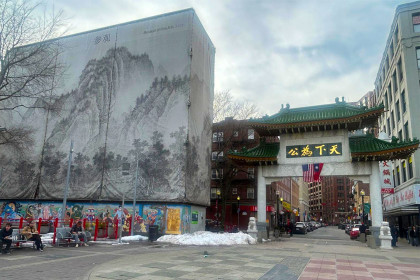
The Chinatown Gate stands at the intersection of Beach Street and Surface Road, directly across from the Greenway. Taiwan's government gave it to Boston in 1982; the current painted-steel structure was installed in 1988 and rededicated in 1990. It has a jade-green tiled roof, a white frame, and two marble foo lions guarding either side.
Look up as you pass under it. The four characters facing the Greenway read "Tian xia wei gong," a phrase from Sun Yat-sen meaning everything under the sky belongs to the people. The four characters on the Beach Street side read "Li yi lian chi," the four social bonds of propriety, justice, integrity, and honor. Both are visible in the photo at the top of this page.
Photo tip: stand in the middle of Beach Street early in the morning, before the delivery trucks arrive, and shoot toward the Greenway. The light hits the roof tiles and the street is empty enough for a clean frame.
Chinatown Park on the Rose Kennedy Greenway
The narrow park at the gate is officially two parks: Auntie Kay and Uncle Frank Chin Park, and Mary Soo Hoo Park, named for the co-founder of Sampan, New England's only Chinese-English newspaper. Together they cover about three quarters of an acre, the largest open space inside the neighborhood.
The design is worth slowing down for. A stretch of pavement is painted as a Chinese chessboard, a traditional symbol of heaven and earth. Bamboo screens the traffic, a serpentine water feature runs through the middle, and there are plantings of cherry, chrysanthemum, and other species native to East Asia. A small Tiananmen memorial sits near the gate. In summer the park hosts outdoor tai chi, community markets, and the neighborhood's festivals.
Murals and Painted Signs on the Side Streets
Most visitors walk straight down Beach Street and miss what is on either side of it. Turn onto Tyler Street, Hudson Street, or Oxford Street and you will find community murals on the older brick walls, many of them telling the story of the laundry workers, garment workers, and families who built the neighborhood. Faded painted advertisements from businesses that closed decades ago still show through on a few buildings. Each fall, the Experience Chinatown Festival adds newly commissioned window murals by local Asian American artists to storefronts across the neighborhood, so the collection changes year to year.
Best Restaurants in Chinatown, Boston
If you have only eaten Chinese food outside a Chinatown, you have not really eaten Chinese food. The restaurants here cook for the community, so portions are generous, menus run long, and prices are lower than almost anywhere else downtown. Arrive before 11 AM on weekends for dim sum; the big rooms fill fast. Addresses below were checked against public listings in September 2026; hours and prices change, so confirm before you go.
Dim Sum: China Pearl and Hei La Moon
China Pearl at 9 Tyler Street is the classic Chinatown dim sum room: a big second-floor dining hall, carts rolling between tables, har gow, siu mai, barbecue pork buns, turnip cake, and egg tarts. It is loud and communal in the best way, and a good first stop if you have never done cart-style dim sum.
Hei La Moon moved to 83 Essex Street, near the gate, and now spreads across two floors. It is one of the largest dim sum halls in the neighborhood, which makes it the easier choice for groups. Order the rice noodle rolls and the sponge cake alongside the usual dumplings.
Soup Dumplings: Nan Xiang Express and Dumpling Cafe
For xiao long bao, the soup dumplings, head to Nan Xiang Express at 52 Beach Street, the storefront that Gourmet Dumpling House occupied for 15 years until it closed in 2022. Nan Xiang opened there in 2023 as the fast-casual branch of a New York soup dumpling house, with about 30 seats, pan-fried pork buns, and siu mai alongside the dumplings. Let each soup dumpling cool for thirty seconds and lift it gently; the broth inside is hot enough to ruin a shirt. Dumpling Cafe at 695 Washington Street is the neighborhood's other soup dumpling specialist, with a longer menu of pan-fried dumplings and Taiwanese street snacks.
Taiwanese: Taiwan Cafe
Taiwan Cafe at 34 Oxford Street has more than 200 items on the menu. Regulars come for the beef noodle soup, the braised pork over rice, the fried pork chop, and the scallion pancakes. It is a good pick for families and for anyone who wants to try something beyond Cantonese cooking.
Malaysian: Penang
Penang at 685 Washington Street is the neighborhood's Malaysian restaurant. Try nasi lemak, the national dish of coconut rice with sambal, anchovies, peanuts, and egg, or the Hainanese chicken rice. Most visitors have never had either, and this is a good place to start.
Bakeries: Ho Yuen and Hing Shing
Chinatown's bakeries bake on site through the day and sell pastries for a dollar or two each, and most of them take cash only. Ho Yuen Bakery at 54 Beach Street is the old-school choice: the same name and signage for decades, char siu bao, pineapple buns, egg tarts, and mooncakes sold year-round rather than only in autumn. Hing Shing Pastry at 67 Beach Street, a few doors from the gate, is known for savory buns and almond cookies. Buy a few and eat them walking; that is how everyone else does it. Two long-running bakeries on Harrison Avenue closed in early 2026 when their building changed hands, so if a guide you are reading names one there, check that it is still open.
Where To Drink in Chinatown, Boston
Chinatown and the Theater District next door have a handful of bars worth seeking out, plus the neighborhood's real signature drink, which is not alcoholic.
Shojo
Shojo at 9A Tyler Street, downstairs from China Pearl, is the neighborhood's best-known bar: loud, dark, and stacked with a whiskey list that surprises people. The cocktails lean Asian (yuzu, lychee, sake) and the bar snacks are good enough to be dinner. It is busiest late on weekends.
Hotel Bars on the Theater District Edge
If you want somewhere quieter and more polished for a drink before or after a show, the cocktail bars inside the hotels along Avery Street and Tremont Street are a two-minute walk from the gate and pull a crowd that knows what it is ordering.
Bubble Tea
Do not skip this. Chinatown has more bubble tea shops per block than anywhere else in Boston, serving brown sugar milk tea, taro, matcha, and fruit teas with tapioca pearls or jelly. It is the right mid-afternoon drink when you have been walking for two hours. Take it to the park and watch the neighborhood go by.
Cultural Experiences and Activities
Food is the reason most visitors come. These are the reasons to stay another hour.
Chinese Historical Society of New England
The Chinese Historical Society of New England is a nonprofit that documents Chinese immigration to the region from the 1870s onward through photographs, oral histories, artifacts, and a walking-tour program that covers the neighborhood's historic sites. It does not keep a permanent walk-in museum, so check its exhibition and tour schedule before you plan around it. When a tour is running, it is the single best way to understand what you are looking at on the side streets.
Pao Arts Center
Pao Arts Center at 99 Albany Street, in the One Greenway building, is Chinatown's first arts and cultural center, opened in 2017 by the Boston Chinatown Neighborhood Center with Bunker Hill Community College. It runs rotating exhibitions by Asian American artists, performances, artist residencies, and the fall Experience Chinatown Festival. Exhibitions are free. The entrance faces the highway on-ramp; use 66 Hudson Street for GPS and walk up the exterior stairs.
Markets and Gift Shops
Even if you are not buying, walking through one of the Chinatown grocery stores is an experience: produce you will not find in a standard supermarket, tanks of live crab and lobster, and shelves of dried mushrooms, fermented black beans, and sauces whose packaging makes no concessions to English. The specialty shops along Essex Street and Beach Street sell hand-painted fans, paper lanterns, tea sets, jade, and calligraphy supplies, none of it mass-produced.
Festivals and Events in Chinatown, Boston
If you can time your Boston trip to one of these, do it. See our Boston annual events guide for dates across the city.
Lunar New Year (January or February)
The biggest event of the year. The neighborhood fills with lion dances and dragon dances that move door to door along Beach Street and Harrison Avenue, firecrackers, food vendors, and a parade that draws crowds from across the city. The Lantern Festival two weeks later closes the season. Arrive early; the sidewalks are packed by mid-morning.
August Moon Festival (August)
Boston Chinatown's summer festival is called the August Moon Festival, and it has run for decades. Expect Chinese opera, folk dance, martial arts demonstrations, lion dance troupes, and food stalls along Beach Street. It is the neighborhood's mid-autumn celebration, held in August rather than in the fall.
Experience Chinatown Festival (Fall)
Organized by Pao Arts Center, this is the newest of the three. Local Asian American artists paint window murals on participating businesses, and the festival weekend adds performances, walking tours, and food. It is the best time to see the neighborhood's public art all at once.
Chinatown Main Street Events
Chinatown Main Street, the neighborhood's business association, runs smaller street fairs and market days through the year. They are relaxed, family-friendly, and a good window into everyday life here. Check its calendar if you are visiting outside festival season.
What's Near Chinatown, Boston
Chinatown sits at a crossroads, which is the strongest argument for putting it in the middle of a day rather than at the end of one.
The Theater District is next door. The Wang Theatre, the Boch Center, and the Emerson Colonial Theatre are all within five minutes on foot. Dim sum followed by a matinee is one of the better Saturdays Boston offers, and the district is also the natural place to continue if you are looking for things to do in Boston at night.
Boston Common is an eight-minute walk up Boylston Street, and the Public Garden with its Swan Boats is just beyond it. The Freedom Trail starts at the Common, so you can walk from lunch in Chinatown into the Massachusetts State House and the rest of colonial Boston without doubling back.
Downtown Crossing is two blocks north on Washington Street for shopping. Head east along the Greenway instead and you reach the Boston Tea Party Museum in about ten minutes, then Quincy Market and the New England Aquarium a little farther along the waterfront.
One Afternoon in Chinatown: A Walking Plan
Start at the gate at 10 AM, before the crowds, and read the inscriptions. Walk down Beach Street and pick up a bun at Hing Shing or Ho Yuen. Duck into a grocery store on Harrison Avenue. At 11, sit down for dim sum at China Pearl or Hei La Moon before the wait builds. After lunch, walk the murals on Tyler and Hudson Streets, then cross Kneeland to Pao Arts Center if an exhibition is on. Finish with a bubble tea in Chinatown Park, then continue up Boylston Street to Boston Common or along the Greenway to the waterfront. Total time inside the neighborhood: about three hours.
Practical Tips for Visiting Chinatown Boston
A few small decisions make the visit smoother.
Best Time To Visit
Spring and fall bring the most comfortable walking weather and thinner crowds. Summer is the busiest season and the one with the August Moon Festival. Winter is cold, but Lunar New Year makes it the most exciting time of year to be here. On any day, weekday mornings are quietest and weekend lunchtimes are the most crowded.
Is Chinatown Safe To Walk At Night?
Chinatown is a busy, lived-in downtown neighborhood, and its main streets (Beach, Harrison, Tyler, Washington) stay active with restaurant traffic well into the evening. Use the same judgment you would in any city center: stay on lit main streets, and be aware that the blocks toward the Theater District and the Common get quieter late. Most visitors find the neighborhood comfortable for dinner and a drink.
Accessibility
The main streets have wide sidewalks and curb cuts, the Chinatown Orange Line stop has elevators, and the Greenway paths are level and step-free. Many of the older restaurants are up a flight of stairs or through a narrow door, though, so if step-free access matters, call ahead. Accessible parking is available at the One Greenway Garage.
Photography
The gate at dawn, the lanterns on Beach Street at dusk, the painted signs on Tyler Street, and the festival lion dances are the shots that make the neighborhood recognizable. Ask before photographing people at work in shops and markets; this is where they live.
See Chinatown With Boston Sightseeing
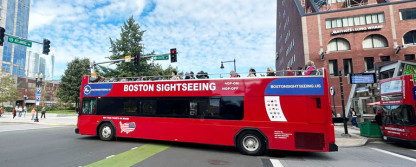
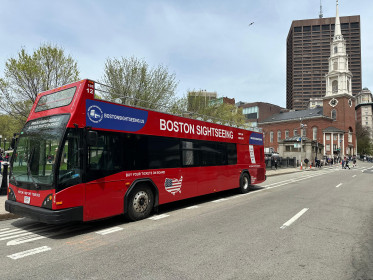
Chinatown is a walking neighborhood, and no bus can replace walking it. What a bus can do is connect it to everything else on this page without the logistics. The Boston Sightseeing hop-on hop-off route stops at Downtown on Tremont Street, about a five-minute walk from the Chinatown Gate, and at Boston Common a few minutes beyond that. Hop off, spend your three hours here, and rejoin the next double-decker to continue to the North End, the waterfront, or Charlestown. Check the hop-on hop-off route map for all 15 stops, or book an all-day pass and board at any of them. If you are trying to fit Chinatown into a single day in the city, our one-day Boston sightseeing itinerary shows where it fits.
Frequently Asked Questions
Does Boston have a Chinatown?
Yes. Boston's Chinatown sits downtown between Downtown Crossing and the Theater District, with its main entrance at the Chinatown Gate on Beach Street at Surface Road. It is the only surviving historic Chinatown in New England.
What is Chinatown Boston famous for?
Chinatown Boston is best known for its restaurants, especially weekend dim sum and soup dumplings, for the 1982 Chinatown Gate, for its bakeries and bubble tea shops, and for its Lunar New Year and August Moon festivals.
Is Chinatown Boston worth visiting?
Yes, particularly for food. It is a working neighborhood rather than a tourist district, so the restaurants, bakeries, and markets are the real thing, and it sits within a ten-minute walk of Boston Common, the Freedom Trail, and the Theater District.
How much time should I spend in Chinatown Boston?
Two to four hours covers the gate, a dim sum meal, the side-street murals, a bakery stop, and the park. Add an hour for Pao Arts Center or a Chinese Historical Society walking tour if one is running.
Where is the nearest T stop to Chinatown Boston?
The Chinatown stop on the Orange Line, on Washington Street, is one block from the gate. Boylston on the Green Line and South Station on the Red Line are each under ten minutes on foot.
What is the best restaurant in Chinatown Boston?
It depends on what you want. China Pearl and Hei La Moon are the classic cart-style dim sum halls, Nan Xiang Express and Dumpling Cafe are the soup dumpling specialists, Taiwan Cafe is the pick for Taiwanese dishes, and Penang covers Malaysian food.
Is Chinatown Boston safe at night?
Its main streets stay busy with restaurant traffic into the evening and most visitors feel comfortable there for dinner. Stay on the lit main streets late at night, as you would anywhere downtown.
Is Chinatown Boston family-friendly?
Yes. Kids tend to like the gate, the lion dances during festivals, the bubble tea, and the bakeries, and everything is within a few flat blocks. For more ideas, see our guide to things to do with kids in Boston.
When is the best time to visit Chinatown Boston?
Spring and fall for weather and crowds; late January or February for Lunar New Year; August for the August Moon Festival. Weekday mornings are the quietest time on any date.

Michael R. Thompson
Writer
Navigating the streets of Boston requires more than just a map; it requires the kind of insight that only 20...
Boston Attractions


Single Ride Pass
$33.25
Explore Boston in 90 Minutes
Ride above the crowd and enjoy the panoramic view of Boston
- Boston City Tour Single Ride Pass
- Stop-1 to Stop-8
- Blue Route Tour
- Double-Decker Bus Tour
- 90 Minutes Tour
- 1 Day Validity
- Hop-on Hop-off Tour
- Charlestown Sightseeing Tour
You might also like
Boston Symphony Hall
Boston Symphony Hall is the historic home of the Boston Symphony Orchestra and the Boston Pops, located at 301 Massachusetts Avenue.
Spring Things To Do in Boston | Boston Sightseeing
Spring is one of the best times to explore Boston, with warmer weather, blooming parks, waterfront activities, outdoor events, and historic...
The Complete Guide to Hop-On Hop-Off Tours in Boston (2026)
Boston is one of America's most walkable cities, but with over 16 Freedom Trail landmarks, waterfront neighborhoods, and historic ballparks.