


Things to Do in Boston Waterfront: Your Complete 2026 Guide
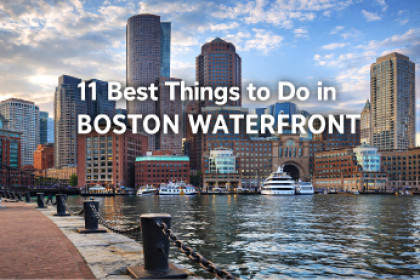
Boston's waterfront is not one place but several, woven together along the harbor's edge. The gleaming Seaport District lines the water with world-class restaurants, rooftop bars, and the city's most talked-about museum. Just behind it, the brick-cobbled streets of Fort Point hide over 300 working artists, chef-owned restaurants that Bostonians fiercely protect as their own, and the most immersive history museum in New England. Beyond both neighborhoods, the Boston Harbor Islands scatter across the water — an archipelago most visitors never discover, and regulars consider their city's secret.
This guide covers everything: the 15 best things to do in Boston Waterfront, where to eat, how to get there without losing half your day to parking, the best time to visit across all four seasons, and a full-day itinerary you can actually follow. Whether you have a long weekend or a single afternoon, you'll leave knowing exactly how to make the most of it.
Know Your Waterfront: Seaport vs. Fort Point
First-time visitors often treat the waterfront as a single neighborhood. Locals know better. Two distinct areas make up what most people call the 'Boston Waterfront,' and understanding the difference helps you plan a day that matches exactly what you're looking for.
The Seaport District
Facing Boston Harbor directly, the Seaport District is the city's most modern neighborhood — a place that, twenty years ago, was parking lots and industrial warehouses, and today is one of the most sought-after ZIP codes on the East Coast. Glass towers line the waterfront. Restaurant rows overlook the harbor. The Institute of Contemporary Art commands the best corner of the waterfront with its cantilevered glass form hovering over the water. Summer nights at Leader Bank Pavilion are legendary. The energy here is high, the dining is exceptional, and the views are unmatched. The Seaport is for visitors who want Boston at its most alive.
Fort Point
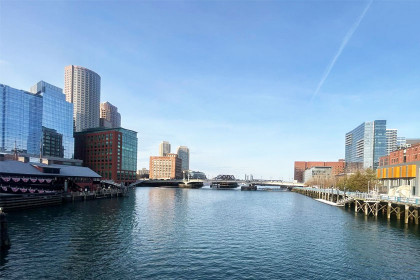
Just south of Seaport, separated by Fort Point Channel, the Fort Point neighborhood offers something the gleaming Seaport doesn't: authenticity. The brick warehouses here were converted not into luxury condos but into artist studios, galleries, and independent restaurants. Congress Street has more chef-owned restaurants per block than most cities have in total. The Boston Tea Party Ships & Museum and the Boston Children's Museum anchor the southern end. Over 300 working artists live and create here — and twice a year, they open their studios to the public. Fort Point is for visitors who want Boston at its most real.
Both neighborhoods are fully walkable from each other and directly served by Boston Sightseeing stops 14, 15, and 16 on the Blue Route. Hop between them freely throughout your day.
The 15 Best Things to Do in Boston Waterfront
From living history to rooftop cocktails, from 200,000-gallon ocean tanks to working artist studios — here are the fifteen experiences that define the Boston waterfront, organized to help you plan your day.
History & Culture
Boston's waterfront is where American history literally happened. These stops bring it back to life in ways that no textbook ever could.
1. Boston Tea Party Ships & Museum
If you visit only one attraction on the Boston waterfront, make it this one. The Boston Tea Party Ships & Museum is the most immersive history experience in the city — and arguably in all of New England. This isn't a museum where you read placards and look at glass cases. This is a museum where you participate.
The guided experience begins on the Congress Street Bridge above Fort Point Channel, in roughly the same spot where, on the night of December 16, 1773, the Sons of Liberty launched the act of defiance that set the American Revolution in motion. Costumed actors play key figures from the night, drawing you into the story with the kind of detail that makes the events feel immediate. You'll stand on the deck of an authentically restored tea ship. You'll throw a crate of tea into the harbor. You'll walk through high-tech interactive exhibits that bring 18th-century Boston to life with a vividness that surprises most adults as much as it delights children.
Plan on 90 minutes minimum — longer if you linger in the exhibits, which most visitors do.
2. New England Aquarium
On the edge of Long Wharf, the New England Aquarium is one of the premier aquariums on the Eastern Seaboard — and the anchor of the downtown waterfront. Its four-story Giant Ocean Tank is the centrepiece: a 200,000-gallon cylindrical reef filled with sea turtles, sharks, barracudas, and hundreds of tropical fish, all circling in a slow, hypnotic spiral around a living coral reef. It is genuinely one of the most remarkable things you can see in Boston, and it never loses its power regardless of how many times you've seen it.
Beyond the Giant Ocean Tank, the aquarium houses penguin colonies, a touch tank full of rays and small sharks, tide pool exhibits, and a jellyfish gallery that is equal parts science and art. The Simons Theatre plays rotating IMAX-style films about ocean exploration and wildlife. And from the aquarium's dock, whale watching cruises depart for Stellwagen Bank — one of the most productive whale watch destinations on the North Atlantic coast — where humpback, finback, and minke whales feed in extraordinary numbers from spring through fall.
3. Institute of Contemporary Art (ICA Boston)
The ICA Boston makes its first impression before you even step inside. The building — designed by Diller Scofidio + Renfro and completed in 2006 — is a dramatic glass and steel form that cantilevers out over Boston Harbor, its upper floors projecting past the building's base like the bow of a ship frozen mid-launch. On a clear day, the harbor reflects the building back at itself in a way that makes the boundary between architecture and water genuinely difficult to locate.
Inside, the ICA presents some of the most ambitious and thought-provoking contemporary art on the East Coast, with exhibitions spanning painting, sculpture, video, installation, and performance from artists who are actively reshaping what those categories mean. The MediaLab on the lower level overlooks the harbor through floor-to-ceiling glass, offering what may be the finest view of Boston Harbor available from any indoor public space. The museum's permanent collection — built entirely since 2006 — is curated with an eye for work that will matter, not just work that already has.
4. Boston Children's Museum
For families with children roughly between the ages of two and ten, the Boston Children's Museum on Fort Point Channel is the single best destination on the entire waterfront. It is loud, wonderfully chaotic, and relentlessly engaging — which is to say, it does exactly what a children's museum should do.
The three-story climbing maze is the centerpiece and a genuine engineering marvel — children disappear into it and emerge, twenty minutes later, flushed and triumphant at the top. Elsewhere in the museum, kids can engineer structures in the construction zone, experiment in the science playground, splash through the water play area, explore a replica Japanese house in the Arthur exhibit, and cycle through dozens of rotating exhibitions that change the experience on every visit. Outside the museum, the recently opened Martin's Park — named for Martin William Richard, the youngest victim of the 2013 Boston Marathon bombing — is a beautiful, accessible playground and waterfront garden overlooking Fort Point Channel that deserves more time than most visitors give it.
Outdoor & On the Water
The waterfront was built for walking, sailing, and taking in views that remind you exactly why Boston was founded on this harbor. Get outside.
5. Boston Harborwalk
The Boston Harborwalk is a 43-mile continuous public walkway that runs along the entire Boston waterfront — and the Seaport section is the finest stretch of the whole route. It is free, always accessible, and genuinely one of the more pleasurable walks in the northeastern United States.
Walking the Harborwalk through Seaport and Fort Point, you'll pass the glass-and-steel facades of waterfront restaurants and hotels, the sleek geometry of the Moakley Federal Courthouse, the grassy arc of Seaport Park, the departure docks for harbor cruises and whale watches, and a sequence of public art installations that change with the seasons. Along the way, benches face the harbor at regular intervals — built for the specific purpose of sitting and watching the boats move across the water. It is one of the few places in Boston where the city slows down to human speed.
At low tide, the rocky shoreline emerges below the Harborwalk, and you can sometimes spot herons hunting along the water's edge less than a mile from the Seaport's rooftop bars. The juxtaposition is very Boston.
6. Boston Harbor Islands
Thirty-four islands hide in plain sight just offshore from downtown Boston — and most visitors to the waterfront never leave the mainland. This is one of the most reliable ways to have a genuinely uncrowded, genuinely beautiful experience in a city that is not always easy to experience quietly.
Spectacle Island is the most popular and the most accessible, reachable by a 20-minute ferry from Long Wharf. The island has a swimming beach, seven miles of hiking trails, a cafe, and a hilltop that offers the single best 360-degree panorama of downtown Boston, the harbor, and the outer islands available anywhere in the area.
The city skyline from Spectacle Island, on a clear summer day, is simply one of the finest city views in America. Castle Island — technically connected to the mainland via a causeway from South Boston — has a 19th-century star-shaped fort, a beloved waterfront snack bar (Sullivan's), and a fishing pier that draws locals year-round. And on Little Brewster Island, Boston Light — the oldest lighthouse in the United States, first lit in 1716 — still operates as an active aid to navigation.
7. Boston Harbor Cruises
There is a version of Boston that you simply cannot see from the shore, and a harbor cruise is the only way to find it. Once you're out on the water, the city reveals itself from the outside — the full sweep of the skyline, the scale of the harbor, the relationship between the downtown towers and the harbor islands, the way the Seaport District drops into the water at its eastern edge. It is a completely different city from this angle, and most visitors who take the cruise say afterwards that it reordered their entire sense of the place.
Options range from the 90-minute narrated sightseeing cruise — the best introduction to the harbor and the most consistently popular choice — to sunset cocktail cruises, weekend brunch sailings, whale watching expeditions, and private charter events. The narrated sightseeing cruise passes the USS Constitution in Charlestown, circles the harbor islands, and covers the full Seaport waterfront from the water, with live commentary throughout.
8. Fan Pier Park & Seaport Common
Not every great waterfront experience requires a ticket or a reservation. Fan Pier Park and Seaport Common — two connected green spaces at the heart of the Seaport — offer front-row harbor views without spending a dollar, and they are among the most pleasant places in Boston to simply be.
Fan Pier Park sits between the glass towers of the Seaport and the harbor's edge, a grassy terrace with benches angled directly at the water, the Harbor Islands visible in the middle distance, and Logan Airport's flight paths crossing overhead at regular intervals if you enjoy watching planes. It is a perfect picnic spot and one of the only places in the Seaport where you can find a moment of genuine quiet on a summer afternoon. Seaport Common, a few blocks away, is the neighborhood's public square — in summer it hosts outdoor concerts, pop-up markets, art installations, and community events almost every weekend.
Arts, Crafts & Live Entertainment
The waterfront's creative scene runs deeper than its glass-tower exterior suggests. Dig beneath the surface, and you'll find one of the most genuinely vibrant arts communities in New England.
9. Fort Point Art Galleries & Open Studios
Over 300 artists — painters, sculptors, photographers, printmakers, ceramicists, digital artists, jewelry makers, and writers — live and work in the converted industrial buildings of Fort Point. This is not a curated arts district designed for tourists. It is a real working creative community that happens to be accessible, and exploring it feels less like visiting a gallery and more like being let in on a city secret.
The Fort Point Arts Community Gallery on A Street holds juried exhibitions of mostly local established artists and is the best single starting point for understanding the neighborhood's creative output. The Society of Arts and Crafts on Pier 4 Boulevard — the oldest nonprofit craft organization in the country — presents work from top contemporary artisans in a space that is genuinely spectacular. Midway Gallery on Channel Street, open weekday mornings and afternoons, shows local and international artists in rotating exhibitions.
Twice each year — typically in May and October — the Fort Point Open Studios event opens the actual working studios of dozens of artists to the public. You can walk into a painter's studio, watch a ceramicist at the wheel, and buy work directly from its maker. It is one of the finest free events in Boston.
10. Leader Bank Pavilion
From Memorial Day weekend through late September, Leader Bank Pavilion hosts the most consistently excellent outdoor concert series in New England. The venue holds 5,000 people in a configuration that feels intimate for its size — open on three sides to the harbor, with a sound system that manages the remarkable trick of being both powerful and perfectly clear, and a sightline from almost every seat that includes either the stage or the Boston skyline or both.
The programming covers an extraordinarily wide range: classic rock acts who still fill arenas, contemporary pop and R&B headliners, country crossover artists, electronic acts, comedy nights, and tribute shows that run the calendar from early June through October. The harbor breeze in summer and the cool autumn air in September create an outdoor concert experience that is very difficult to replicate indoors, and the memory of watching a favourite artist perform against a darkening Boston skyline tends to stay with visitors for a long time.
11. Lawn on D
Tucked behind the Boston Convention & Exhibition Center on D Street, the Lawn on D is the waterfront's most playful public space — and one of the most distinctive outdoor experiences in the city. It is a place designed specifically to make adults feel like children, which it accomplishes with an effectiveness that is both surprising and immediately endearing.
The signature feature is a series of large circular swings that illuminate in shifting colors after dark, creating a light installation that doubles as active furniture. Alongside the swings, the Lawn offers oversized lawn games — giant chess, lawn checkers, enormous Connect Four, cornhole, and bocce — available free to anyone who wanders in. Throughout the summer, the Lawn hosts free lunchtime concerts, free art installations, kids' events, and a beer and wine pavilion that keeps adults occupied while children exhaust themselves on the games. On evenings without ticketed events, it is simply a very pleasant outdoor space where Boston comes to unwind.
Eat, Drink & Socialize
The Seaport District has more waterfront dining per square mile than anywhere else in Boston — and the quality of that dining, across a remarkable range of price points and cuisines, matches the extraordinary views.
12. Harpoon Brewery & Beer Hall
Harpoon Brewery, founded in 1986, was Boston's first craft brewery — and it remains, four decades later, the largest specialty brewer in New England. Its home base on Northern Avenue in the Seaport is both a working production facility and one of the most convivial gathering places on the entire waterfront.
Daily tours (usually departing at 11 AM) take you through the brewing operation with a clarity and enthusiasm that makes the process genuinely fascinating, regardless of your existing knowledge of beer. The full Beer Hall is open daily for tastings, pints, and food — with a menu designed to pair with the brewery's rotating lineup of ales, IPAs, seasonals, and limited releases. The outdoor beer garden operates through the warmer months. And each October, Harpoon hosts its legendary Octoberfest, which draws thousands of visitors over two weekends and regularly sells out months in advance — a local tradition that has become one of the unmissable events on the Boston fall calendar.
13. Seaport & Fort Point Dining
The waterfront's restaurant scene is large enough to fill a separate guide entirely, but these are the places that consistently earn their reputations and deserve a place in your planning.
Seafood
• Legal Harborside (270 Northern Ave) — the flagship of the Legal Sea Foods family, spread across three floors with different concepts on each: casual take-away on the ground floor, full-service mid-level dining, and an upscale rooftop experience with the best harbor view from any restaurant table in Boston. Reserve the top floor 2–3 weeks ahead for summer weekends.
• Row 34 (383 Congress St, Fort Point) — a superb oyster bar and seafood restaurant that sources directly from New England fishing communities. The raw bar is the best reason to come; the lobster roll is the second-best. A Fort Point institution.
• Barking Crab (88 Sleeper St) — the waterfront's great casual institution: an open-air seafood shack under a bright red tent, serving enormous portions of fried clams, steamed lobster, and seafood baskets. No reservations, long lines, and worth every minute of the wait.
Bars & Rooftops
• Lookout Rooftop & Bar (70 Sleeper St, atop The Envoy Hotel) — the best rooftop bar on the waterfront, with a full harbor panorama and a cocktail list sophisticated enough to match the view. Arrive before sunset; the skyline transition is the point.
• Trillium Beer Garden on the Greenway — the Fort Point brewery's seasonal outdoor beer garden, operating May through October on the Rose Kennedy Greenway. New England farmhouse ales in the open air, steps from the waterfront.
Fine Dining
• Woods Hill Pier 4 (1 Pier 4 Blvd) — farm-to-table American cuisine from chef Charlie Foster, sourced almost entirely from the restaurant's own farm network. The food is quietly extraordinary, and the harbor view is the best in the Seaport's fine dining tier.
• Strega Italiano Seaport — classic Italian cuisine in a polished setting; the Sunday brunch is a neighborhood favourite.
• Ocean Prime (2 Seaport Ln) — a sophisticated steakhouse and seafood hybrid with one of the more refined dining rooms on the waterfront.
Hidden Gems — The Waterfront Beyond the Obvious
These are the spots that separate a great Boston waterfront day from a remarkable one. The places your travel app might not suggest, but the ones that residents quietly treasure.
14. Fallen Heroes Memorial
In Seaport Park along Seaport Boulevard, rising fifty feet above the harbor walkway, the Fallen Heroes Memorial honours all Massachusetts service members killed in Iraq and Afghanistan since September 11, 2001. It is one of the newest war memorials in Boston — dedicated in 2016 — and one of the most architecturally striking.
The memorial takes the form of a five-sided obelisk, with each face representing one branch of the United States military. The material changes character with the light — in midday sun, the pale stone shimmers and seems almost to dissolve at its peak; in the blue hour before sunset, it holds a quiet gravity that seems to press against the air around it. At night, internal lighting makes it visible from across the harbour and from various points in downtown Boston. Most waterfront visitors pass it without stopping. It deserves a moment.
15. Snowport — Boston's Winter Holiday Market
Every November, the Seaport waterfront undergoes a transformation that most visitors don't know to expect. Snowport — Boston's winter holiday market — opens in the first week of November and runs through the first of January, turning the outdoor spaces around 100 Seaport Boulevard into one of the finest seasonal markets on the East Coast.
Over 120 small businesses set up in artisan chalets and market stalls across the site: handmade jewellery, local art, ceramics, clothing, home goods, and gifts that are decidedly harder to find than anything at a shopping mall. The food and beverage offerings — freshly made waffles, hot chocolate in a dozen variations, mulled wine, craft beer, seasonal cocktails — are exceptional by any market standard. Outdoor activities include ice-less curling, carnival games, a Christmas tree market, and the annual Light Up Seaport ceremony in early December, when the neighborhood's holiday lighting turns on in a coordinated event that fills the waterfront and is, frankly, magical.
See the Boston Waterfront with Boston Sightseeing
Covering the Boston waterfront on your own requires planning, patience, and a detailed understanding of a neighbourhood spread across more than two miles of coastline. Parking is expensive, limited, and a reliable source of afternoon frustration. Rideshares between attractions add up quickly. Walking everything is achievable — and exhausting. The hop-on hop-off format solves the logistical problem while adding something no rideshare or walking tour can offer: the open-top perspective.
Why Hop-On Hop-Off Is the Smartest Way to Cover the Waterfront
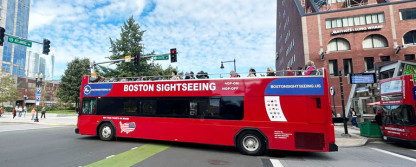
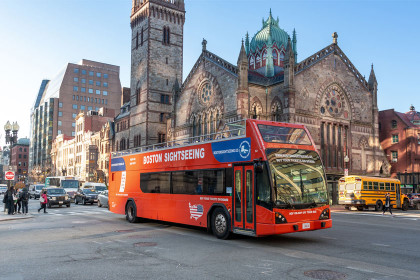
From the upper deck of a Boston Sightseeing double-decker bus, the waterfront reveals itself in a way that street-level exploration never quite matches. You see the relationship between Seaport and Fort Point from above. You watch the harbor open up as the route turns onto Northern Avenue. You get the skyline and the water in the same frame, at the same time, without paying for a harbor cruise.
The hop-on hop-off option means you set your own pace entirely. Spend two hours at the New England Aquarium, catch the next bus — which arrives every 30 minutes — and hop off at the Tea Party Museum for as long as you need. No group to keep up with. No guide pulling you away from the exhibit that caught your attention. The bus is the framework; you fill it however the day suggests.
Boston Sightseeing Blue Route — Waterfront Stops at a Glance
Getting to the Boston Waterfront
The Boston waterfront is one of the easier areas of the city to reach, from almost any direction, and without a car. If you're staying anywhere in downtown Boston, the simplest and most scenic way to reach the waterfront is to board a Boston Sightseeing bus at 206 Atlantic Ave (Stop 1) and ride the Blue Route directly to waterfront stops 14, 15, or 16.
The bus runs every 30 minutes from 9:30 AM, and you'll arrive with a panoramic view of the route already in your memory. This is the option we recommend, and the one that makes your arrival part of the experience rather than a logistical obstacle.
Best Time to Visit the Boston Waterfront
The Boston waterfront rewards visits in every season — but each season offers a fundamentally different experience. Here is what to expect, and how to make the most of your timing.
Spring (April–May) — The Underrated Season
Spring on the Boston waterfront is a secret that rewards the travellers who plan ahead. Crowds are a fraction of summer levels, hotel rates are lower, and the major attractions — the Aquarium, Tea Party Museum, ICA, and Children's Museum — operate at full capacity without the summer queues. The Harborwalk blooms in April as the surrounding green spaces come back to life, and the Fort Point Open Studios event in May is one of the finest free events on the Boston calendar.
From the upper deck of the Boston Sightseeing bus, spring offers something summer can't: visibility without heat haze, and comfortable open-top riding conditions that summer afternoons sometimes make difficult. If your travel dates are flexible, late April and May offer exceptional value.
Summer (June–August) — Peak Season
Summer is the Boston waterfront at its most alive, and it is worth the crowds if you plan for them. Leader Bank Pavilion runs concerts nearly every night. The Harbor Islands are fully operational, the harbor cruise schedule is at maximum frequency, Lawn on D buzzes with events, and every waterfront restaurant operates at full capacity. The outdoor energy of a Boston summer evening in Seaport — warm air, harbour breeze, city lights beginning to reflect off the water — is genuinely difficult to replicate.
The trade-offs are real: book everything in advance. Tea Party Museum tickets, ICA time-entry slots on busy weekends, dinner reservations at Legal Harborside and Row 34, and Boston Sightseeing bus passes all sell out. The visitors who enjoy summer the most are the ones who booked everything before they arrived.
Fall (September–November) — The Best Overall Season
Ask any Boston local when to visit the waterfront, and the honest answer is September and October. The weather is reliably mild and sunny through mid-October. The summer crowds dissipate after Labor Day, but the attractions remain fully open. The foliage along the Harborwalk turns gold and copper in late October, creating a backdrop against the harbor that is quietly spectacular. Harpoon Octoberfest draws thousands but adds energy rather than inconvenience. And when November arrives, Snowport transforms the waterfront into its most magical seasonal incarnation.
Fall is also the season when the Boston Sightseeing open-top deck is at its most comfortable — cool air, crystal visibility, and foliage views that summer simply cannot offer.
Winter (December–March) — For the Brave and the Rewarded
Winter visits require preparation but offer rewards that other seasons don't. Snowport runs through January 1, and the combination of fairy lights, harbour reflections, mulled wine, and the relative quiet of the waterfront in December creates an atmosphere that feels genuinely apart from the rest of the city. The ICA is open year-round, the Tea Party Museum and Children's Museum operate full winter schedules, and Harpoon's Beer Hall provides obvious shelter.
The Boston Sightseeing bus runs year-round. Dress warmly for the open-top deck in winter — or ride the enclosed lower level on particularly cold days. The views don't change with the temperature.
Where to Stay Near Boston Waterfront
Staying in or near the Seaport District puts you within walking distance of the waterfront's best restaurants, attractions, and the Boston Sightseeing bus stops that connect you to the rest of the city. These are the most consistently recommended options.
• Seaport Hotel & World Trade Center (1 Seaport Lane) — directly on the harbour, steps from the ICA and Leader Bank Pavilion. The most waterfront-proximate luxury hotel in the district.
• Renaissance Boston Waterfront Hotel (606 Congress St) — premium location on Congress Street; easy walking access to Fort Point dining, Tea Party Museum, and Children's Museum.
• InterContinental Boston (510 Atlantic Ave) — harbour views and walking distance to the Aquarium, Long Wharf, and downtown. A strong choice for visitors splitting time between the waterfront and historic Boston.
• The Westin Boston Seaport District (425 Summer St) — large, reliably excellent, and well-positioned for the Convention Center area and the Lawn on D. Strong family choice.
• Residence Inn Boston Harbor on Tudor Wharf (34-44 Charles River Ave, Charlestown) — suites with kitchen facilities and harbour views; excellent value for longer stays or families who want more space.
Plan Your Boston Waterfront Day
Boston's waterfront is the kind of place that gives back in proportion to what you put into it. Come for a single attraction, and you'll leave having only scratched the surface. Come with a plan — a pass that lets you move freely, a reservation or two for the things that fill up, and the knowledge of where to look for the harbour views and the hidden galleries and the quiet parks that the main itineraries miss — and you'll leave understanding why people come back here, season after season, and still find something worth their attention.
We created the Boston Sightseeing Hop-On Hop-Off tour specifically so that the logistics of a day like that disappear. The bus connects the dots. The narration fills in the history. The upper deck gives you the views. The rest is yours to fill as the day unfolds.
FAQ

Michael R. Thompson
Writer
Navigating the streets of Boston requires more than just a map; it requires the kind of insight that only 20...
Boston Attractions


Single Ride Pass
$33.25
Explore Boston in 90 Minutes
Ride above the crowd and enjoy the panoramic view of Boston
- Boston City Tour Single Ride Pass
- Stop-1 to Stop-8
- Blue Route Tour
- Double-Decker Bus Tour
- 90 Minutes Tour
- 1 Day Validity
- Hop-on Hop-off Tour
- Charlestown Sightseeing Tour
You might also like
Top Things to Do in Fort Point Channel, Boston
If you stroll just across the Summer Street bridge from South Station, you will find yourself surrounded by towering brick warehouses.
Freedom Trail Boston: Complete Guide to Landmarks, History & Tours
Step into the heartbeat of history, where cobblestone streets echo with the whispers of revolution, hope, and courage. The Freedom Trail in.....
Historical Attractions in Boston
Boston is one of America's most historic cities, attracting visitors who want to explore famous historical attractions in Boston.