


West End Boston
The West End is a small neighborhood on the northwest edge of downtown Boston, bordered by the Charles River, Beacon Hill, and the North End. It's best known today as the area around TD Garden and North Station. Still, for much of its history it was one of Boston's most densely populated immigrant neighborhoods, home to over 20,000 Irish, Jewish, Italian, and other immigrant families at its early-20th-century peak, until a 1958 urban renewal project demolished nearly all of it.
This guide covers where the West End actually is, what the neighborhood looked like before and after urban renewal, and which historic buildings and sites survived into the present day.
Where Is the West End?
The West End sits on the northwest portion of Boston's original Shawmut Peninsula, bounded by Cambridge Street to the south, the Charles River to the west and northwest, North Washington Street to the north and northeast, and New Sudbury Street to the east. Beacon Hill sits directly south, the North End is just east across a short stretch of downtown, and Cambridge's Kendall Square and North Point neighborhoods sit across the Charles River.
Much of the neighborhood's land is not original. Starting in 1807, the city used fill from nearby Beacon Hill to close in a small bay and mill pond that once separated the West End from the North End, expanding the peninsula to roughly its present shape. The neighborhood spans zip codes 02114 and 02142, and its own Green Line stop, Science Park/West End, sits right at its edge.
Early History: Bulfinch and the West End's Wealthy Years
In the late 18th and early 19th centuries, as Boston's older waterfront and North End grew crowded, wealthier residents began developing the West End instead. Architect Charles Bulfinch, who shaped much of Boston's early architectural character, designed many of the mansions built there in the 1790s, including the first Harrison Gray Otis House, one of three homes Bulfinch designed for the prominent lawyer and one of the few buildings that survived the neighborhood's later demolition. Bulfinch also designed the domed granite building completed in 1816 that is now Massachusetts General Hospital's Bulfinch Pavilion, and the West End Market, built in 1810 at the corner of Grove and Cambridge Streets, though the market itself did not survive 20th century redevelopment.
By 1810, the West End was home to wealthy merchants and lawyers. Many later moved to nearby Beacon Hill, and the West End's character shifted toward the immigrant and working-class neighborhood it would be known as for the next century.
An Immigrant and African American Neighborhood
In the early 19th century, the West End, alongside Beacon Hill's north slope, became one of the most important centers of Boston's African American community. Free Black residents held a political voice there decades before it was common elsewhere in the country, with at least one West End resident sitting on Boston's community council every year between 1876 and 1895.
Through the second half of the 19th century and into the 20th, wave after wave of immigrant groups settled in the West End, including Irish, Italian, and Eastern European Jewish families, along with smaller communities of Armenians, Greeks, Lebanese, Poles, and Ukrainians. Ward boss Martin Lomasney, known locally as "the Mahatma," built a political base there through the Hendricks Club, providing social services and support to immigrant families in exchange for their votes. By the early 20th century, the neighborhood's population had grown past 20,000 residents.
The Jewish community built its own institutions in the West End, including the 1919 Vilna Shul, which remained the last of roughly seven neighborhood synagogues to stay open before closing in 1985. Actor Leonard Nimoy grew up in this community, and later credited a hand gesture used by the Kohanim, the ancient Israelite priests, that he saw over the Vilna Shul's ark as the inspiration for the Vulcan salute in Star Trek.
The 1958 Urban Renewal and Demolition
By the 1950s, decades of decline had already shrunk the West End well below its early-20th-century peak, down to around 11,000 residents in 1956 and fewer than 8,000 by 1958, and city officials had labeled the shrinking neighborhood a slum, though many residents disputed that characterization. In 1953, Boston officials announced a redevelopment plan for the neighborhood. Despite organized opposition from residents, including the Save the West End committee, the city pressed forward. Eviction notices went out on April 25, 1958, and the Boston Redevelopment Authority leveled roughly 46 acres of the neighborhood, displacing nearly all of the West End's remaining residents, estimated at somewhere between 7,000 and 8,000 people, to make way for a small number of residential high-rise towers.
The demolition has been widely criticized in the decades since, both for its scale and for how it was carried out. Many displaced families were relocated to housing that cost more than what they had been paying, and the loss of the neighborhood's tight-knit community left a lasting mark on former residents. In 2015, Boston Redevelopment Authority director Brian P. Golden formally apologized on behalf of the agency for the demolition.
What Remains and What's There Today
Only a handful of buildings survived the demolition. The first Harrison Gray Otis House still stands as a museum you can visit, and the 1851 Charles Street Jail was later converted into the Liberty Hotel rather than torn down. St. Joseph's Church, built in 1834 and one of the few structures spared by the 1958 project, still holds services on Cardinal O'Connell Way and remains a gathering point for former West End families. The Bulfinch Triangle, a small pocket bounded by Causeway, Merrimac, and North Washington Streets, still holds some of the commercial buildings that predate urban renewal. One residential building, known as "The Last Tenement" at 42 Lomasney Way, survived multiple redevelopment attempts and two fires and remains the only tenement structure left in the neighborhood.
Most of the cleared land became something else entirely. Massachusetts General Hospital expanded through the northwest section, the former Scollay Square became Government Center to the south, and much of the northern part of the neighborhood is now covered by North Station and TD Garden. The West End Museum keeps a permanent exhibition on the neighborhood's history, and the West End Community Center runs an annual West End Children's Festival to help keep some of that community spirit alive.
Near TD Garden, West End Johnnie's has become one of the neighborhood's most recognizable current spots, a sports bar popular with fans heading to Celtics and Bruins games that leans into the neighborhood's immigrant food history on its menu. Right at the neighborhood's river edge, the Museum of Science sits on the Charles River Dam Bridge, reachable from the Science Park/West End T stop, and it's the closest thing the West End has to a dedicated tourist attraction today.
That mix of historic survivors and modern institutions means the West End works less as a single destination and more as a neighborhood worth passing through on the way to somewhere else, which is exactly how most visitors actually experience it.
Nearby Neighborhoods and Attractions
The West End connects easily on foot to a few of Boston's better-known stops. Beacon Hill sits immediately south, and the North End is a short walk east across downtown. Along the water, the Charles River and its Esplanade run just past the neighborhood's western edge, reachable by crossing the Longfellow Bridge or the Charles River Dam Bridge.
Why Choose Boston Sightseeing
Most visitors reach the West End on their way to a game or concert at TD Garden, which makes it easy to pair with the rest of a Boston sightseeing day rather than treating it as a separate stop.
- Flexible hop-on-hop-off access: Hop off near TD Garden or North Station, take in the neighborhood's surviving landmarks, and rejoin the route when you're ready to move on.
- Multiple tour options for every schedule: Choose from a 90-minute Single Ride Pass up to full tour packages that combine the West End with the rest of downtown Boston.
- Live commentary from local guides: Our guides cover the history behind the neighborhoods you pass, including the story of urban renewal that reshaped so much of the West End.
- Built for first-time visitors: Double-decker buses and mobile-friendly ticketing make it simple to add the West End to a day that also covers Beacon Hill and the North End.
Frequently Asked Questions
Where is the West End in Boston?
The West End sits on the northwest edge of downtown Boston, bounded by Cambridge Street to the south, the Charles River to the west, North Washington Street to the north, and New Sudbury Street to the east. Beacon Hill borders it directly to the south.
What happened to the West End neighborhood?
In 1958, the Boston Redevelopment Authority demolished roughly 46 acres of the West End as part of an urban renewal project, displacing the West End's remaining residents, estimated at somewhere between 7,000 and 8,000 people. The original immigrant neighborhood was replaced with residential high-rises, and the city's redevelopment authority formally apologized for the demolition in 2015.
What are the best things to do in the West End?
Most visitors see the West End's surviving landmarks, the Otis House, St. Joseph's Church, and the Bulfinch Triangle, on their way to TD Garden or the nearby Museum of Science. The West End Museum offers the deepest look at the neighborhood's history if you have extra time.
Is anything left of the original West End?
Yes, though only a few buildings survived. The first Harrison Gray Otis House, the former Charles Street Jail (now the Liberty Hotel), the Bulfinch Triangle's commercial buildings, and a single tenement building at 42 Lomasney Way are among the handful of structures that predate the 1958 demolition.
What is in the West End now?
Massachusetts General Hospital, TD Garden, North Station, and part of Government Center now occupy much of the neighborhood's original footprint, alongside newer residential high-rises and a small commercial strip in the Bulfinch Triangle.
Is the West End a good area to visit?
Most visitors pass through the West End on their way to TD Garden or North Station rather than visiting it as a standalone destination, but the surviving historic buildings and the West End Museum offer a genuine look at one of Boston's most significant and difficult urban planning stories.
How do I get to the West End?
The West End is walkable from Beacon Hill and the North End, and it's directly served by North Station, which connects to the MBTA Green and Orange Lines as well as the regional commuter rail system.
Plan Your Boston Tour with Boston Sightseeing
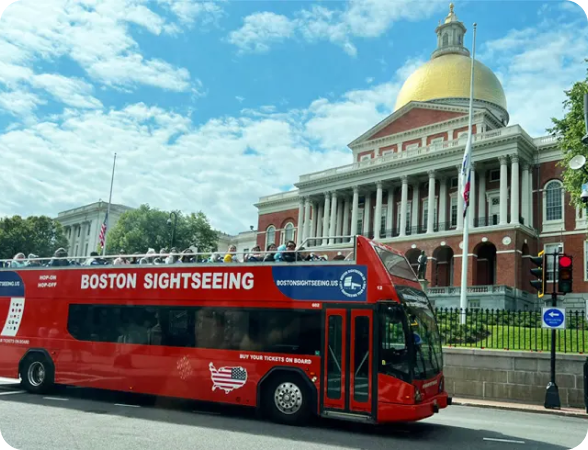
To make the most of your Boston tour and see the West End as part of a city-wide exploration, leverage the Boston Sightseeing Double-Decker Bus. Our hop-on, hop-off service takes you on a comprehensive tour of Boston's most iconic landmarks and neighborhoods, including the West End. With live commentary, you'll learn about the city's history and culture while creating a personalized itinerary that suits your interests and schedule.
Our Tour Packages
Single Ride Pass
$33.25
Explore Boston in 90 Minutes
Ride above the crowd and enjoy the panoramic view of Boston
- Boston City Tour Single Ride Pass
- Stop-1 to Stop-8
- Blue Route Tour
- Double-Decker Bus Tour
- 90 Minutes Tour
- 1 Day Validity
- Hop-on Hop-off Tour
- Charlestown Sightseeing Tour
Hop-On Hop-Off All Day
$41.55
Boston City Sightseeing Tour
Experience historic Boston with unlimited hop-on hop-off at your own pace.
- Stop-1 to Stop-8
- Hop-on Hop-off Boston Tour
- Blue Route Tour
- Double-Decker Bus Tour
- 90 Minutes tour
- 1 Day Validity
- Shuttle Bus Service
- Charlestown Tour
Hop-on Hop-off Boston & Charlestown Tour
$48.65
Boston & Charlestown Tour
Experience the charm of Boston & Charlestown with Boston Sightseeing at your own pace.
- Hop-on Hop-off Boston Tour
- Stop-1 to Stop-11
- Hop-on Hop-off Charlestown Tour
- Blue & Orange Route Tour
- Double-Decker Bus Tour
- Shuttle Bus Tour
- 120 Minutes Tour
- 1 Day Validity
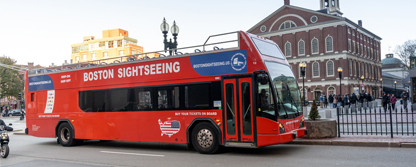
2 Days Boston & Charlestown Hop-On Hop-Off Tour
$70.40
2 Days Boston & Charlestown Tour
Explore Boston & Charlestown with Boston's first double-decker bus at your own pace.
- Hop-on Hop-off Boston Tour
- Stop-1 to Stop-11
- Hop-on Hop-off Charlestown Tour
- Blue & Orange Route Tour
- Double-Decker Bus Tour
- Shuttle Bus Tour
- 120 Minutes Tour
- 2 Days Validity
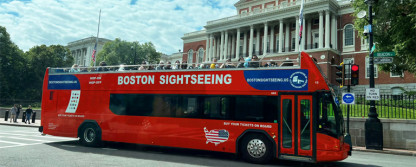
Cruise Terminal Hop-On Hop-Off Tour
$52.00
200 Minutes Hop-on Hop-off
Get onboard from Boston Cruise terminal and explore the historic beantown with Boston Sightseeing double-decker bus.
- Hop-on Hop-off Boston Tour
- Stop 1-8, 12-15
- Blue & Purple Route Tour
- Double-Decker Bus Tour
- Shuttle Bus Tour
- 200 Minutes Tour
- 1 Day Validity
- Charlestown Tour
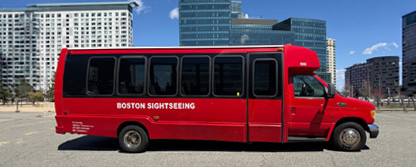
Boston & Cambridge City Tour
$63.00
Guided Photo & City Tour
A 3.5-hour guided shuttle tour featuring Boston’s most iconic neighborhoods, Cambridge highlights, waterfront views, and curated photo opportunities.
- Guided Boston & Cambridge sightseeing tour
- Approximately 3.5 hours
- Curated stops and photo opportunities
- Climate-controlled shuttle bus transportation
- Live local tour guide
- 45-minutes Quincy Market lunch break
- Same-day tour experience
- Double-Decker Bus Service
- Hop-on, hop-off service
Attractions To Explore Near This Stop
10 Best Things To Do In East Boston
East Boston is one of Boston's most diverse and scenic neighborhoods, offering a unique mix of waterfront parks, beaches, & outdoor recreation.
Things To Do From The Black Falcon Cruise Terminal In Boston
The Black Falcon Cruise Terminal, now officially known as Flynn Cruiseport Boston, is one of New England's busiest cruise terminals.
Hop-On Hop-Off Boston: Same-Day Tickets & Tour Info
A Boston Sightseeing hop-on hop-off ticket works the same day you buy it. There is no waiting period and no requirement to book days in advance.