


Beacon Hill Boston
Beacon Hill is one of Boston's oldest and most recognizable neighborhoods, rising just north of Boston Common and the Boston Public Garden. Its narrow cobblestone streets, gas lamps, and brick Federal-style row houses have changed so little over two centuries that the entire neighborhood is protected as a historic district. Beacon Hill is also home to the gold-domed Massachusetts State House, which sits at the top of the hill the neighborhood is named for.
Visitors usually come for the same handful of reasons: to photograph Acorn Street, to walk past the historic homes on Louisburg Square, or to see the State House up close. But Beacon Hill also holds one of the most important sites in Black American history, a scattering of small museums inside original 19th-century homes, and a shopping and dining strip along Charles Street that locals use every day. This guide covers the neighborhood's boundaries, history, landmarks, and how to fit it into a Boston Sightseeing tour.
Where Is Beacon Hill?
Beacon Hill sits between four streets: Cambridge Street to the north, Beacon Street to the south, Storrow Drive to the west along the Charles River, and Bowdoin Street to the east. The neighborhood covers roughly half a square mile, small enough to cross on foot in about fifteen minutes.
The closest MBTA stops are Charles/MGH on the Red Line, on the neighborhood's western edge near the river, and Park Street on the Red and Green Lines, a short walk from the State House. There are no T stops inside Beacon Hill itself, so most visitors arrive by walking in from one of these stations. Street parking is limited and largely metered, so walking, rideshare, or the T are all more practical than driving.
History
Before it became a residential neighborhood, Beacon Hill was three separate hills. Two of them, Mount Vernon and Pemberton Hill, were leveled between 1807 and 1832, cutting the remaining hill down from roughly 138 feet to about 80 feet, and the fill was used to expand Boston's shoreline elsewhere in the city. Around the same time, a group called the Mount Vernon Proprietors, one of the earliest land development companies in the country, bought about 18 acres west of the State House and began building the neighborhood that stands today.
The Massachusetts State House itself was completed in 1798 on land that was once part of John Hancock's estate. Architect Charles Bulfinch designed the building, and his influence carried into the row houses built across the hill in the following decades, which is part of why so much of the neighborhood shares a consistent Federal and Greek Revival look.
That consistency is protected by law. Boston established the Historic Beacon Hill District in 1955, one of the earliest local historic districts in the country, and expanded it several times since, most recently in 2024. The federal government went further in 1962, designating Beacon Hill a National Historic Landmark District, and the whole neighborhood was added to the National Register of Historic Places in 1966. Any exterior change visible from a public street, including views from Boston Common, the Public Garden, and the Charles River Esplanade, has to go through the Beacon Hill Architectural Commission, which is why the streetscape has stayed so consistent for so long.
Beacon Hill's Black History
The north slope of Beacon Hill was home to one of the largest free Black communities in the United States before the Civil War. At the center of that community stands the African Meeting House, built in 1806 and now the oldest Black church building still standing in the country. Frederick Douglass and William Lloyd Garrison both spoke there, and the building served as a meeting place for abolitionists for decades before the neighborhood's Black community later moved to Boston's South End.
The Meeting House is now part of the Museum of African American History, and it anchors the Black Heritage Trail, a walking route through the north slope that connects several sites tied to this history. It's one of the most significant places in Beacon Hill, and one of the easiest to miss if you only visit Acorn Street and the State House.
Landmarks and Museums to Visit
Beacon Hill packs an unusual number of small, specific landmarks into a short walk.
Massachusetts State House
The gold dome that marks the top of the hill covers the seat of Massachusetts state government, and its steps offer one of the better views back down toward Boston Common.
Acorn Street
Often called the most photographed street in America, Acorn Street's cobblestones and Federal-style row houses date to the 1820s, and the street itself is barely a block long.
Louisburg Square
A private, gated park surrounded by some of the most expensive homes in Boston, Louisburg Square is the closest thing Beacon Hill has to a postcard image of old New England wealth.
Nichols House Museum
A preserved 19th-century home open for public tours, the Nichols House Museum gives visitors a rare look inside one of the row houses that make up the rest of the neighborhood's streetscape.
Harrison Gray Otis House
Designed by Charles Bulfinch and built in 1796, the Harrison Gray Otis House shows what a grand Federal-era Boston home looked like before most of Beacon Hill was even developed.
Boston Athenaeum
One of the oldest independent libraries in the country, the Boston Athenaeum holds a collection of historic books and art, with limited public access outside of scheduled tours and exhibitions.
Shopping and Dining on Charles Street
Charles Street runs along the base of the hill and works as Beacon Hill's main street, lined with antique shops, small boutiques, cafes, and restaurants that serve the neighborhood's residents as much as its visitors. The Charles Street Meeting House anchors one end of the street. At the other end sits Cheers Pub, the bar that inspired the exterior shots in the television show Cheers and one of the most recognizable stops in the neighborhood for visitors who grew up watching it.
Nearby Attractions
Beacon Hill's location makes it easy to fold into a longer day of sightseeing. Boston Common and the Public Garden sit directly at the base of the hill, and the Freedom Trail passes close enough that most visitors combine the two. Faneuil Hall Marketplace is a short walk from the State House side of the neighborhood, with shopping, food stalls, and its own Revolutionary War history.
Things to Do in Beacon Hill
Between the landmarks above, the shops on Charles Street, and the hidden garden courtyards tucked behind the row houses, Beacon Hill rewards slow, unplanned walking as much as it rewards a checklist. For a fuller list of stops, walking routes, and seasonal events, our Things to Do in Beacon Hill guide breaks the neighborhood down block by block.
One seasonal note worth knowing ahead of time: many of Beacon Hill's private courtyard gardens, normally hidden behind the row houses, open to the public one day a year, typically the third Thursday in May, through the Beacon Hill Hidden Gardens Tour. If your visit lines up with spring in Boston, it's worth checking the current year's date.
Why Choose Boston Sightseeing?
Beacon Hill is dense with things to see but light on parking, which makes it a natural stop on a hop-on-hop-off route rather than a neighborhood to drive into.
- Flexible hop-on-hop-off access: Hop off near the State House or Charles Street, spend as long as you want exploring on foot, and rejoin the route when you're ready to move on.
- Multiple tour options for every schedule: Choose from a 90-minute Single Ride Pass up to longer tour packages that combine Beacon Hill with Charlestown or Cambridge.
- Live commentary from local guides: Live commentary covers the history behind the State House, the historic district, and the neighborhood's role in Boston's development.
- Built for first-time visitors: Double-decker buses and mobile-friendly ticketing make it easy to add Beacon Hill to a day that also covers the Freedom Trail, Faneuil Hall, and the waterfront.
Frequently Asked Questions
Where is Beacon Hill in Boston?
Beacon Hill sits just north of Boston Common, bounded by Cambridge Street to the north, Beacon Street to the south, Storrow Drive to the west, and Bowdoin Street to the east. The closest T stops are Charles/MGH and Park Street.
What is Beacon Hill known for?
Beacon Hill is known for its cobblestone streets, gas lamps, and Federal-style brick row houses, most of which date to the early 1800s and remain protected as part of a National Historic Landmark District. It's also home to the Massachusetts State House and the African Meeting House, the oldest Black church building still standing in the country.
What is the history of Beacon Hill?
Beacon Hill was developed in the early 1800s after two of its original three hills were leveled to help fill in Boston's shoreline. The Massachusetts State House was completed there in 1798, and the surrounding streets were built out over the following decades by the Mount Vernon Proprietors, one of the country's earliest land development companies.
What are the best things to do in Beacon Hill?
Most visitors walk Acorn Street, see the State House, and browse Charles Street's shops and cafes. History-focused visitors should also see the African Meeting House and the Black Heritage Trail. Our Things to Do in Beacon Hill guide covers a fuller list and suggested routes.
Is Beacon Hill free to visit?
Yes. Walking the streets, viewing Acorn Street and Louisburg Square from public sidewalks, and visiting Boston Common at the base of the hill all cost nothing. Individual museums, like the Nichols House Museum and the Harrison Gray Otis House, charge separate admission.
Is Beacon Hill safe to walk around?
Yes. Beacon Hill is a quiet, primarily residential neighborhood with steady foot traffic during the day. As with any city neighborhood, visitors should stay on public walkways and respect that most of the buildings are private homes.
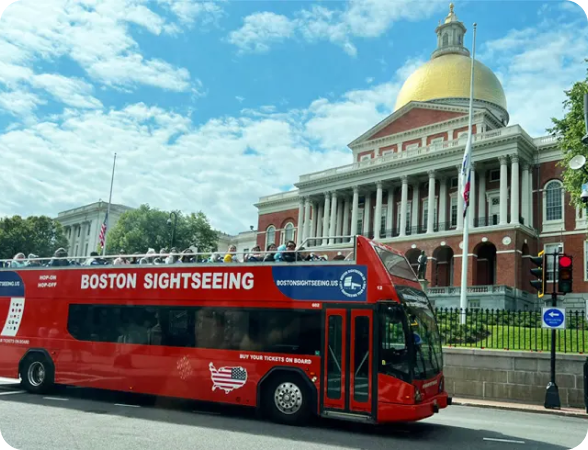
Planning a Tour with Boston Sightseeing
One of the best ways to experience Beacon Hill and its surrounding areas is by taking a tour on the Boston Sightseeing Double-decker bus. Our hop-on hop-off bus tour allows you to see all the top sights in Beacon Hill at your own pace. You can hop off at any stop, explore the area on foot, and then hop back on the next bus to continue your tour. With entertaining and informative commentary about the neighborhood's history and pointing out notable landmarks along the way, you will experience an unforgettable sightseeing tour.
Our Tour Packages
Single Ride Pass
$33.25
Explore Boston in 90 Minutes
Ride above the crowd and enjoy the panoramic view of Boston
- Boston City Tour Single Ride Pass
- Stop-1 to Stop-8
- Blue Route Tour
- Double-Decker Bus Tour
- 90 Minutes Tour
- 1 Day Validity
- Hop-on Hop-off Tour
- Charlestown Sightseeing Tour
Hop-On Hop-Off All Day
$41.55
Boston City Sightseeing Tour
Experience historic Boston with unlimited hop-on hop-off at your own pace.
- Stop-1 to Stop-8
- Hop-on Hop-off Boston Tour
- Blue Route Tour
- Double-Decker Bus Tour
- 90 Minutes tour
- 1 Day Validity
- Shuttle Bus Service
- Charlestown Tour
Hop-on Hop-off Boston & Charlestown Tour
$48.65
Boston & Charlestown Tour
Experience the charm of Boston & Charlestown with Boston Sightseeing at your own pace.
- Hop-on Hop-off Boston Tour
- Stop-1 to Stop-11
- Hop-on Hop-off Charlestown Tour
- Blue & Orange Route Tour
- Double-Decker Bus Tour
- Shuttle Bus Tour
- 120 Minutes Tour
- 1 Day Validity
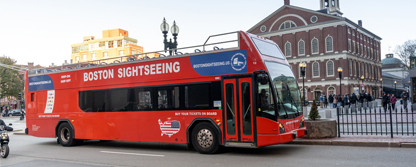
2 Days Boston & Charlestown Hop-On Hop-Off Tour
$70.40
2 Days Boston & Charlestown Tour
Explore Boston & Charlestown with Boston's first double-decker bus at your own pace.
- Hop-on Hop-off Boston Tour
- Stop-1 to Stop-11
- Hop-on Hop-off Charlestown Tour
- Blue & Orange Route Tour
- Double-Decker Bus Tour
- Shuttle Bus Tour
- 120 Minutes Tour
- 2 Days Validity
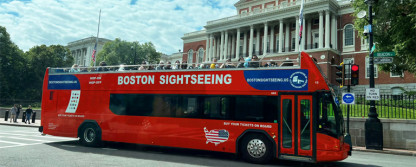
Cruise Terminal Hop-On Hop-Off Tour
$52.00
200 Minutes Hop-on Hop-off
Get onboard from Boston Cruise terminal and explore the historic beantown with Boston Sightseeing double-decker bus.
- Hop-on Hop-off Boston Tour
- Stop 1-8, 12-15
- Blue & Purple Route Tour
- Double-Decker Bus Tour
- Shuttle Bus Tour
- 200 Minutes Tour
- 1 Day Validity
- Charlestown Tour
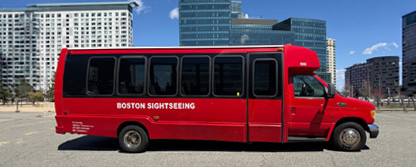
Boston & Cambridge City Tour
$63.00
Guided Photo & City Tour
A 3.5-hour guided shuttle tour featuring Boston’s most iconic neighborhoods, Cambridge highlights, waterfront views, and curated photo opportunities.
- Guided Boston & Cambridge sightseeing tour
- Approximately 3.5 hours
- Curated stops and photo opportunities
- Climate-controlled shuttle bus transportation
- Live local tour guide
- 45-minutes Quincy Market lunch break
- Same-day tour experience
- Double-Decker Bus Service
- Hop-on, hop-off service
Attractions To Explore Near This Stop
20 Reasons to Visit Boston for Your Next Trip | Boston Sightseeing
Boston is one of the most visited cities in the United States, attracting travelers with its rich history, iconic landmarks, waterfront scenery.

Romantic Things To Do in Boston
Boston Sightseeing offers a wide variety of romantic attractions, waterfront experiences, historic neighborhoods, scenic walks, and date-night.
Top Things to Do in Boston in 2026
Boston is one of America's most rewarding destinations, offering a unique blend of history, culture, and waterfront attractions.