


King's Chapel Burying Ground
King's Chapel Burying Ground, on Tremont Street in downtown Boston, is the city's oldest burying ground. The City of Boston dates it to 1630, which makes it older than the church beside it, and it is one of the sites on the Freedom Trail. Some visitors call it the King's Chapel cemetery or burial ground. It holds John Winthrop, the first governor of the Massachusetts Bay Colony, along with ministers, merchants and early settlers from the 17th and 18th centuries. The site is small, but it has carved slate stones, old stone tombs and a few famous legends. This page covers its history, who is buried here, what to look for, the hours and how to reach it on foot or by Boston Sightseeing bus.
Location
King's Chapel Burying Ground sits on Tremont Street between School Street and Park Street, next to King's Chapel, which is at 58 Tremont Street. It is easy to fit into a walk through the older part of downtown Boston, and it sits on the Freedom Trail between Boston Common and the Old State House.
History
The burying ground is older than most of the buildings around it, and its story has three parts: how it began, how the chapel came to share the block, and how it changed over the centuries.
How The Burying Ground Began
According to the City of Boston, the burying ground dates to 1630, the year Boston was settled. Tradition says Isaac Johnson, who owned the land, was the first person buried here. For its first three decades it was Boston's only burying ground. By about 1660 it was crowded enough that newer grounds, including the Granary and Copp's Hill, opened to relieve the pressure.
How King's Chapel Came To Share The Land
In the late 1680s, the royal governor, Edmund Andros, took part of the burying ground to build an Anglican church, King's Chapel. Local people resisted the order, but the church went up. That is why the burying ground carries the chapel's name, and it is also why many visitors assume the two are one site. They are not. The City of Boston owns and maintains the burying ground, and the church is a separate congregation. The granite chapel you see today was finished in 1754 and designed by Peter Harrison.
How It Changed Over Time
Most burials here ended in 1796, although a few burials in the tombs continued into the 1800s. In the early 1800s, the City added paths, a decorative iron fence and plantings, and it set the gravestones in straight rows. As a result, many stones no longer sit over the graves they mark. The City estimates that well over a thousand people were buried here, and a 1985 survey counted 586 surviving markers.
Who Is Buried At King's Chapel Burying Ground
Several well-known figures from early Massachusetts rest here:
- John Winthrop (died 1649), the first governor of the Massachusetts Bay Colony. His tomb also names members of his family.
- John Cotton (died 1652), a leading Puritan minister.
- Mary Chilton (died around 1679), a Mayflower passenger. Tradition names her as the first woman to step off the Mayflower.
- Hezekiah Usher (died 1676), an early Boston bookseller and publisher.
- Elizabeth Pain (died 1704), whose marker has its own legend, described below.
- Isaac Johnson, the landowner whom tradition names as the first person buried here, in 1630.
The City also notes that free and enslaved Black Bostonians were buried here. A marker for William Dawes, who rode with Paul Revere in 1775, also stands here, although the City says his remains were moved to Forest Hills Cemetery in the 19th century.
What To See
Most visitors spend their time reading stones. The paths are short, so you can cover the whole ground in a single loop, and the details reward a slow look.
Gravestone Carvings
The colonial slate stones carry the symbols Puritan families used to remind the living that life is short. Look for winged skulls, skeletons and hourglasses. Tabletop tombs, which wealthy families often paid for, stand among the slate. Rows of underground tombs run along the eastern edge and along Tremont Street, built in the 1700s.
Joseph Tapping's Stone
Near the front of the burying ground, Joseph Tapping's stone shows a skeleton and Father Time struggling over death. One local guide suggests it may be Boston's most beautiful headstone. It is easy to spot, so it makes a good first stop.
Elizabeth Pain's Marker
Elizabeth Pain's stone is dated 1704 and reads "Here lies Elizabeth Pain, wife to Samuel Pain." It is decorated with a coat of arms and a winged skull. Some guides say it inspired the gravestone of Hester Prynne in Nathaniel Hawthorne's 1850 novel, The Scarlet Letter. That link is a belief, not a proven fact, but it gives the stone a story worth telling.
Winthrop's Tomb
The tomb of John Winthrop is one of the best-known monuments here, and it names several family members who are buried alongside him. It is a useful reminder that in the 1600s this was the town's main burying ground, and the city grew up around it.
Visiting King's Chapel Burying Ground
Hours and rules can change, so treat this section as a guide and confirm with the City of Boston before you go. These details were checked in October 2026.
Hours
The City of Boston lists the burying ground among those open daily from about 9 a.m. to 4 p.m. Hours can change, so check with the City before you go, especially for a Sunday visit.
Cost
Visiting the burying ground is free, according to Time Out. King's Chapel next door is a separate site with its own hours, and admission or tour tickets may apply there, so check the chapel's website for current times and prices.
Accessibility
The Freedom Trail lists King's Chapel and its burying ground as wheelchair accessible. Ask the City's Parks and Recreation department about the paths before you go.
How Long To Plan
Plan for a short stop of roughly 15 to 30 minutes, longer if you like to read every inscription.
Nearby Attractions
The burying ground sits in a tight stretch of Freedom Trail sites, so what you see next depends on how much time you have.
King's Chapel, right beside the burying ground, is an example of Georgian architecture, and it offers guided tours that include its crypt and bell tower. The crypt is inside the church, not in the burying ground. The Granary Burying Ground, a short walk away on the Freedom Trail, opened in 1660 and holds Samuel Adams, John Hancock and Paul Revere. Together, the two grounds make a good comparison, since this one is older and the Granary holds more Revolutionary leaders.
Farther along School Street, the trail leads to more stops:
- The Boston Latin School site is a very short walk from the chapel.
- The Old Corner Bookstore is on the same stretch of the trail.
- The Old South Meeting House is where colonists gathered on December 16, 1773, before the Boston Tea Party.
- The Old State House is our Stop 2, so it is an easy place to rejoin the bus.
- Park Street Church and Boston Common lie the other way, toward the start of the trail.
For a longer route, see our guide to historical attractions in Boston.
Frequently Asked Questions
Is King's Chapel Burying Ground the oldest cemetery in Boston?
Yes, by most accounts. The City of Boston dates it to 1630, and several sources call it the city's oldest burying ground. A few sources give a slightly different founding year, but they agree it was Boston's first.
Is King's Chapel Burying Ground the same as King's Chapel?
No. They are neighbors, but the church is a separate congregation, while the burying ground is owned and maintained by the City of Boston. Entry to the burying ground is separate from a visit to the chapel, which has its own tickets and tours (see King's Chapel in Boston).
What is the difference between King's Chapel Burying Ground and Granary Burying Ground?
King's Chapel Burying Ground is older, dating to 1630, and holds John Winthrop. The Granary dates to 1660 and holds Samuel Adams, John Hancock and Paul Revere. Both are on the Freedom Trail and close together.
How much does it cost to visit King's Chapel Burying Ground?
It is free, according to Time Out. The chapel next door has its own tickets for guided tours.
What are the hours of King's Chapel Burying Ground?
The City of Boston lists it among the burying grounds open daily from about 9 a.m. to 4 p.m. Confirm current hours with the City before you go.
Is the King's Chapel crypt part of the burying ground?
No. The crypt is beneath the church, and you reach it through the chapel's own guided tours. See our page on King's Chapel in Boston for the church itself.
Is King's Chapel Burying Ground haunted?
Like many colonial burying grounds, it has ghost stories attached to it, but there is no documented proof of anything beyond the legends. The City lists daytime hours, so plan to visit then.
Is King's Chapel Burying Ground on the Freedom Trail?
Yes. It is one of the 16 sites on the 2.5-mile Freedom Trail, a short walk from the Granary Burying Ground.
How do I get to King's Chapel Burying Ground on the Boston Sightseeing bus?
Get off at Stop 3 in Downtown Boston, on Tremont Street, and walk toward School Street. Stop 2 at the Old State House is the other nearby stop. Every ticket that lets you hop off includes both stops, and the Single Ride Pass is one loop, so check its ticket page for hop-off details.
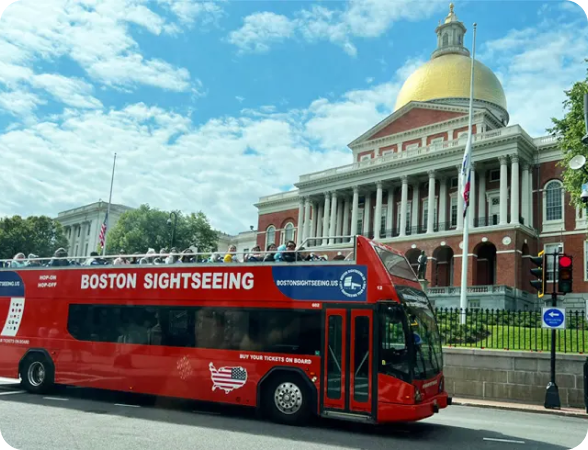
Planning Your Tour
For an all-encompassing experience of King's Chapel Burying Ground and other popular attractions in Boston, consider taking a hop-on hop-off tour with the Boston Sightseeing double-decker bus. A bus ride lets you cover the downtown sights without retracing your steps, and you can stop here when the route reaches Downtown Boston.
Our Tour Packages
Single Ride Pass
$33.25
Explore Boston in 90 Minutes
Ride above the crowd and enjoy the panoramic view of Boston
- Boston City Tour Single Ride Pass
- Stop-1 to Stop-8
- Blue Route Tour
- Double-Decker Bus Tour
- 90 Minutes Tour
- 1 Day Validity
- Hop-on Hop-off Tour
- Charlestown Sightseeing Tour

Hop-On Hop-Off All Day
$41.55
Boston City Sightseeing Tour
Experience historic Boston with unlimited hop-on hop-off at your own pace.
- Stop-1 to Stop-8
- Hop-on Hop-off Boston Tour
- Blue Route Tour
- Double-Decker Bus Tour
- 90 Minutes tour
- 1 Day Validity
- Shuttle Bus Service
- Charlestown Tour

Hop-on Hop-off Boston & Charlestown Tour
$48.65
Boston & Charlestown Tour
Experience the charm of Boston & Charlestown with Boston Sightseeing at your own pace.
- Hop-on Hop-off Boston Tour
- Stop-1 to Stop-11
- Hop-on Hop-off Charlestown Tour
- Blue & Orange Route Tour
- Double-Decker Bus Tour
- Shuttle Bus Tour
- 120 Minutes Tour
- 1 Day Validity
2 Days Boston & Charlestown Hop-On Hop-Off Tour
$70.40
2 Days Boston & Charlestown Tour
Explore Boston & Charlestown with Boston's first double-decker bus at your own pace.
- Hop-on Hop-off Boston Tour
- Stop-1 to Stop-11
- Hop-on Hop-off Charlestown Tour
- Blue & Orange Route Tour
- Double-Decker Bus Tour
- Shuttle Bus Tour
- 120 Minutes Tour
- 2 Days Validity
Cruise Terminal Hop-On Hop-Off Tour
$52.00
200 Minutes Hop-on Hop-off
Get onboard from Boston Cruise terminal and explore the historic beantown with Boston Sightseeing double-decker bus.
- Hop-on Hop-off Boston Tour
- Stop 1-8, 12-15
- Blue & Purple Route Tour
- Double-Decker Bus Tour
- Shuttle Bus Tour
- 200 Minutes Tour
- 1 Day Validity
- Charlestown Tour

Boston & Cambridge City Tour
$63.00
Guided Photo & City Tour
A 3.5-hour guided shuttle tour featuring Boston’s most iconic neighborhoods, Cambridge highlights, waterfront views, and curated photo opportunities.
- Guided Boston & Cambridge sightseeing tour
- Approximately 3.5 hours
- Curated stops and photo opportunities
- Climate-controlled shuttle bus transportation
- Live local tour guide
- 45-minutes Quincy Market lunch break
- Same-day tour experience
- Double-Decker Bus Service
- Hop-on, hop-off service
Attractions To Explore Near This Stop
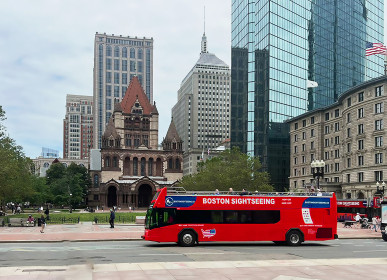
Best 10 Tourist Attractions in Boston
Boston was founded on the Shawmut Peninsula in 1630, and few American cities pack as much history into such a small area.

Local Guide to Boston: Top Attractions, Hidden Gems & Local Experiences
Boston is one of the most historic and walkable cities in the United States, offering a unique blend of Revolutionary War landmarks.
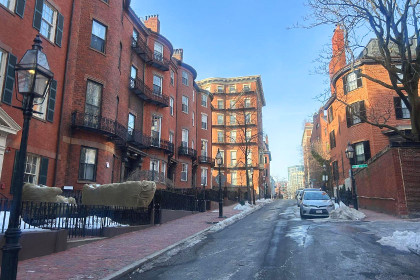
Best Things To Do In Beacon Hill
Beacon Hill is Boston's most historically rich and visually iconic neighborhood — a compact, walkable enclave of Federal-style rowhouses, cobble