


Walking Through History: The New England Holocaust Memorial
The New England Holocaust Memorial stands in Carmen Park, a small green space along the Freedom Trail in downtown Boston, as a public tribute to the six million Jews and other victims systematically murdered during the Holocaust. Six glass towers rise above a black granite path, each one etched with numbers and lit from within, creating a space meant for quiet reflection rather than display. The memorial is free, outdoors, and open at all hours, and it sits close enough to Faneuil Hall and the Old State House that most visitors reach it on foot as part of a wider walk through the Freedom Trail. This guide covers where to find it, what the towers mean, the words inscribed along the path, and how to visit respectfully as part of a Boston trip.
Where Is the Memorial Located?
Carmen Park sits along Congress and Union Streets in downtown Boston, at 98 Union Street, and the park itself was named for William Carmen in recognition of his role in helping create the memorial. The park is a short walk from Faneuil Hall and Quincy Market, right along the Freedom Trail's red brick route, which makes it an easy stop to combine with the rest of a downtown Boston walk. The closest MBTA stop is Haymarket, served by the Green and Orange Lines, about two minutes away on foot; Government Center and State Street are slightly farther alternatives on the Blue, Green, and Orange Lines. Metered street parking exists nearby, though spots can be hard to find, and the Haymarket and Government Center garages are the more reliable paid options.
The Meaning Behind the Six Towers
Each of the six glass towers rises 54 feet into the air, and together they carry several layers of meaning at once. Individually, each tower represents one of the six major Nazi extermination camps: Majdanek, Chełmno, Sobibor, Treblinka, Bełżec, and Auschwitz-Birkenau. As a group, the six towers also evoke the candles of a menorah, and they stand for the six million Jewish victims of the Holocaust and the six years of mass extermination between 1939 and 1945. Every tower is etched with seven-digit numbers, 2,280,960 of them across the full memorial, echoing the tattooed identification numbers branded onto prisoners' arms in the camps. Steam rises from grates in the dark path below, and small lights flicker beneath the glass, so that walking the length of the memorial feels less like viewing a monument and more like passing through one.
The Inscriptions and Quotes
Survivor testimony is etched directly into the memorial's glass and granite, turning the walk itself into an act of listening. On the Sobibor tower, a panel carries the words of Alexander Pechersky, who led an uprising and mass escape from that camp, resolving not simply to escape but to fight back. Another panel carries words from Gerda Weissmann Klein, describing a childhood friend who found a single raspberry in the camp and carried it all day before giving it away that night. At the end of the path, a black granite panel bears a well-known quotation attributed to Lutheran pastor Martin Niemöller, who wrote of staying silent as the Nazis came first for the Communists, then the Jews, then the trade unionists, then the Catholics, and finally for him, by which point no one was left to speak up.
Who Created the Memorial
The memorial opened to the public in 1995, founded by Stephan Ross, a Holocaust survivor who settled in Boston after the war and spent years working to see it built. San Francisco architect Stanley Saitowitz designed the six towers and the granite path that connects them. Today, the site is maintained by Boston National Historical Park, part of the National Park Service, and the Jewish Community Relations Council coordinates guided tours of the memorial.
The memorial has also faced real threats over the years, a history that shows exactly why it continues to matter. In 2001, federal agents arrested two white supremacists who had been planning to blow up this memorial along with the United States Holocaust Memorial Museum; a jury convicted them in 2002. Glass panels were deliberately smashed in June and August of 2017, and the memorial has been the site of further vandalism and provocation since, most recently in 2023. Each time, the Boston Jewish community and the memorial's caretakers have restored and reopened the site, which is itself part of the story visitors encounter when they walk through it today.
Visiting the Memorial Today
There's no admission fee and no ticket required. The memorial is an outdoor public space open to visitors at any hour, year-round. Most people spend somewhere between twenty minutes and an hour walking its length, reading the inscriptions, and taking in the towers, though there's no set pace expected. For a deeper visit, a self-guided Mobile Tour, accessible by QR code since 2021, adds survivor interviews and historical context straight to your phone as you walk, and the Jewish Community Relations Council also offers guided group tours booked in advance for anyone who wants a docent-led visit. A Virtual Tour with 3D photos is available online as well, for anyone planning ahead or unable to visit in person.
Nearby on the Freedom Trail
Because Carmen Park sits directly on the Freedom Trail, it connects naturally to several other stops within a short walk. Faneuil Hall and its surrounding marketplace sit just around the corner, and the Old State House, one of Boston's oldest public buildings, is a few minutes further along the trail. The Boston Massacre Site, marking the spot where British soldiers fired on a crowd of colonists in 1770, sits right beside the Old State House, making it easy to pair a visit to the memorial with several centuries of Boston history in a single walk.
Plan Your Visit With Boston Sightseeing
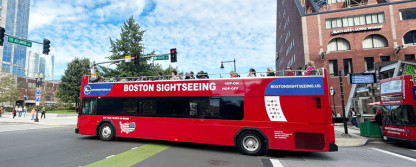
To visit the New England Holocaust Memorial as part of a Boston Sightseeing tour, hop off the double-decker bus at Stop 1, New England Aquarium, which also covers the Faneuil Hall Marketplace area closest to Carmen Park. From there, it's a short walk to the memorial. Once you've spent time at the site, you can hop back on and continue exploring the rest of downtown Boston. The open-top buses run at regular intervals throughout the day with live commentary along the route, so there's no need to plan your timing precisely; just hop off wherever you want to stop, and hop back on when you're ready to keep moving. Boston Sightseeing can help you build a full day around the Freedom Trail, with the New England Holocaust Memorial as one meaningful stop along the way.
Frequently Asked Questions
Is the New England Holocaust Memorial a museum?
No. It's an outdoor memorial made up of six glass towers and a granite path, not a museum with indoor exhibits or a collection. Visitors who are looking for a traditional museum experience should know this is a reflective public space instead.
Do I need a ticket to visit the memorial?
No ticket or admission fee is required. The memorial is a free, outdoor public space that's open to visitors at all hours, year-round.
What do the six towers represent?
Each tower represents one of six major Nazi extermination camps, and together the six towers also evoke a menorah's candles and stand for six million Jewish victims and six years of mass extermination, from 1939 to 1945.
How tall are the towers?
Each of the six glass towers stands 54 feet tall.
Where is the nearest T stop to the memorial?
Haymarket Station, served by the Green and Orange Lines, is the closest, about a two-minute walk. Government Center and State Street are slightly farther alternatives.
Can I take a guided tour of the memorial?
Yes. The Jewish Community Relations Council offers guided group tours booked in advance, and a self-guided Mobile Tour, available by QR code, is also there for anyone visiting on their own.
Who designed the New England Holocaust Memorial and when did it open?
San Francisco architect Stanley Saitowitz designed the memorial, which opened to the public in 1995 after years of effort led by founder Stephan Ross, a Holocaust survivor.

Michael R. Thompson
Writer
Navigating the streets of Boston requires more than just a map; it requires the kind of insight that only 20...
Boston Attractions


Single Ride Pass
$33.25
Explore Boston in 90 Minutes
Ride above the crowd and enjoy the panoramic view of Boston
- Boston City Tour Single Ride Pass
- Stop-1 to Stop-8
- Blue Route Tour
- Double-Decker Bus Tour
- 90 Minutes Tour
- 1 Day Validity
- Hop-on Hop-off Tour
- Charlestown Sightseeing Tour
You might also like
Hop-On Hop-Off Boston: Same-Day Tickets & Tour Info
A Boston Sightseeing hop-on hop-off ticket works the same day you buy it. There is no waiting period and no requirement to book days in advance.
20 Reasons to Visit Boston for Your Next Trip | Boston Sightseeing
Boston is one of the most visited cities in the United States, attracting travelers with its rich history, iconic landmarks, waterfront scenery.

Things To Do With Kids in Boston | Boston Sightseeing
Boston offers a wide variety of family-friendly attractions, interactive museums, waterfront experiences, parks, and sightseeing activities ....